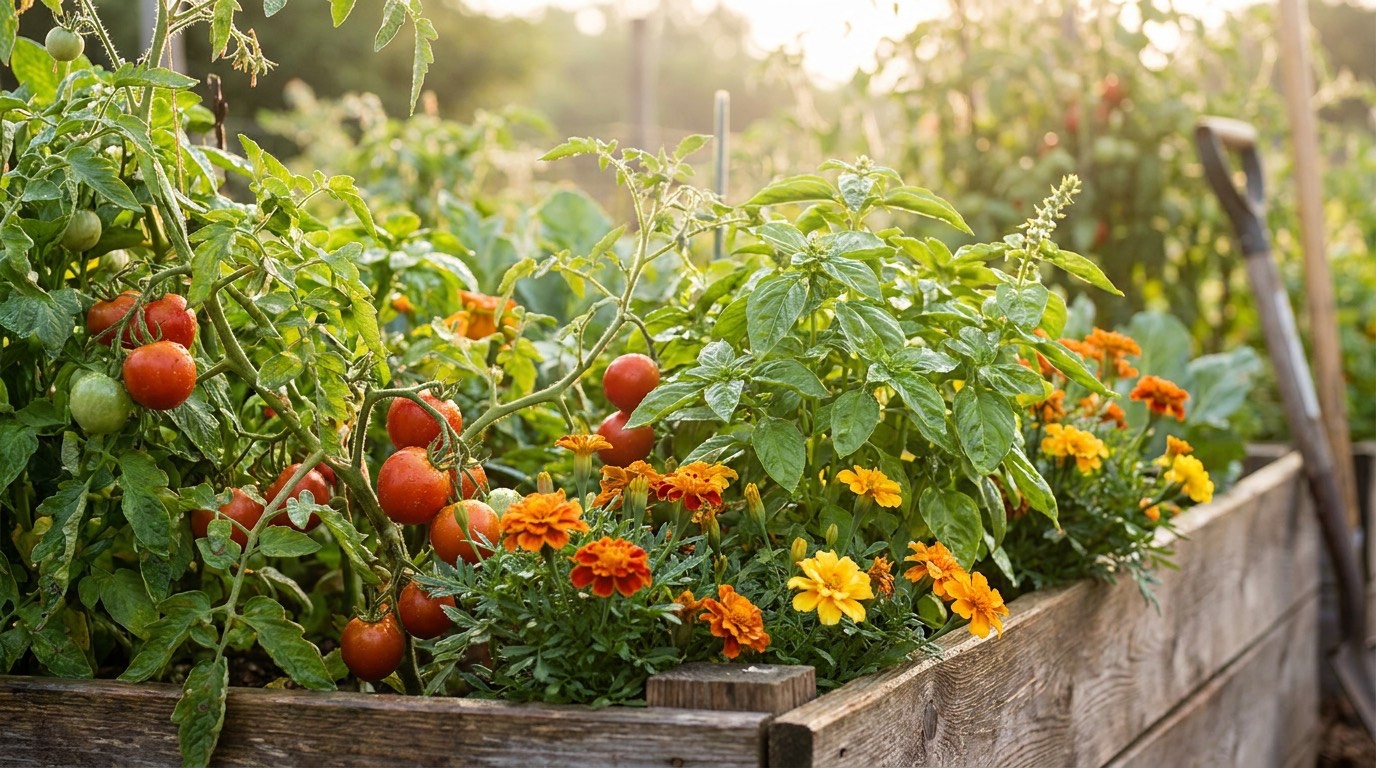
Companion planting is the old gardener's practice of growing certain plants near each other for mutual benefit — pest control, better pollination, and smarter use of space. Some of it is well-supported, some is folklore, but the core ideas genuinely help, and they make a garden more productive and more resilient without any extra work. You're going to plant something in that space anyway — companion planting just means choosing wisely.
Here's what actually works, minus the myths.
The one pairing every garden should have
Plant flowers among your vegetables. Marigolds, calendula, nasturtiums, and zinnias draw in pollinators and pest-eating predators, and some help deter pests directly. It's the simplest, most reliable companion-planting move there is — and it makes the veg patch beautiful.
How companion planting helps
- Pest control: strongly scented plants (herbs, marigolds, onions) can mask or repel pests that hunt by smell.
- Attracting helpers: flowers and herbs that bloom pull in bees for pollination and ladybugs and lacewings that eat pests.
- Using space and light: tall plants shade heat-sensitive ones; sprawling plants cover soil as living mulch; quick crops fill gaps between slow ones.
- Support: the classic "Three Sisters" — corn supports climbing beans, beans feed the soil with nitrogen, and squash shades out weeds below.
Pairings that work
- Tomatoes + basil — basil is said to improve tomato flavor and helps repel some pests (and they're perfect together on the plate).
- Carrots + onions — each masks the scent that draws the other's pests (carrot fly, onion fly).
- Beans + corn + squash — the Three Sisters, a complete team.
- Lettuce + tall crops (tomatoes, beans) — the taller plants shade tender lettuce and slow it from bolting in heat.
- Cabbage family + strong herbs (dill, thyme, sage) — aromatic herbs help confuse cabbage pests.
- Almost anything + marigolds or nasturtiums — pollinator magnets and pest decoys.
Combinations to avoid
A few plants genuinely compete or spread problems:
- Beans and onions/garlic — the alliums can stunt legumes.
- Tomatoes and brassicas (cabbage, broccoli) — heavy feeders that compete hard.
- Fennel — grows poorly with most vegetables; give it its own corner.
- Mint (and other spreaders) — helpful scent, but so invasive it should always be in its own pot.
Keep it simple
You don't need a complex master plan. Two easy principles carry most of the benefit: mix flowers and herbs throughout your vegetable beds, and don't grow big blocks of a single crop (monocultures are a buffet for pests). Diversity is the real secret behind companion planting.
Companion planting made simple
- Tuck flowers and herbs among your vegetables — the highest-value habit.
- Grow the Three Sisters (corn, beans, squash) as a proven team.
- Pair carrots with onions, tomatoes with basil, lettuce under taller crops.
- Avoid beans-with-onions and tomatoes-with-brassicas.
- Mix it up — diversity beats big single-crop blocks.
A note on the science
Some companion-planting claims are backed by solid research (nitrogen-fixing legumes, trap crops, pollinator attraction); others are traditional lore that's harder to prove. The reassuring part: even the unproven pairings rarely hurt, and the underlying strategy — a diverse, flower-filled, pollinator-friendly garden — is exactly what makes any garden healthier. So experiment freely and keep what works for you.
Frequently Asked Questions
What should I plant next to tomatoes?
Basil is the classic partner — it may help repel pests and pairs perfectly in the kitchen. Marigolds, nasturtiums, carrots, and lettuce also do well nearby. Avoid planting tomatoes right beside brassicas like cabbage and broccoli, which compete heavily.
Does companion planting really work?
Parts of it are well-supported — legumes enrich the soil, flowers attract pollinators and pest predators, and strong scents can deter some pests. Other pairings are traditional lore. Either way, the core strategy of a diverse, flower-filled garden reliably makes plants healthier.
What are the Three Sisters?
Corn, beans, and squash grown together: the corn gives the beans something to climb, the beans fix nitrogen to feed all three, and the sprawling squash shades the soil and suppresses weeds. It's the most famous and effective companion-planting trio.