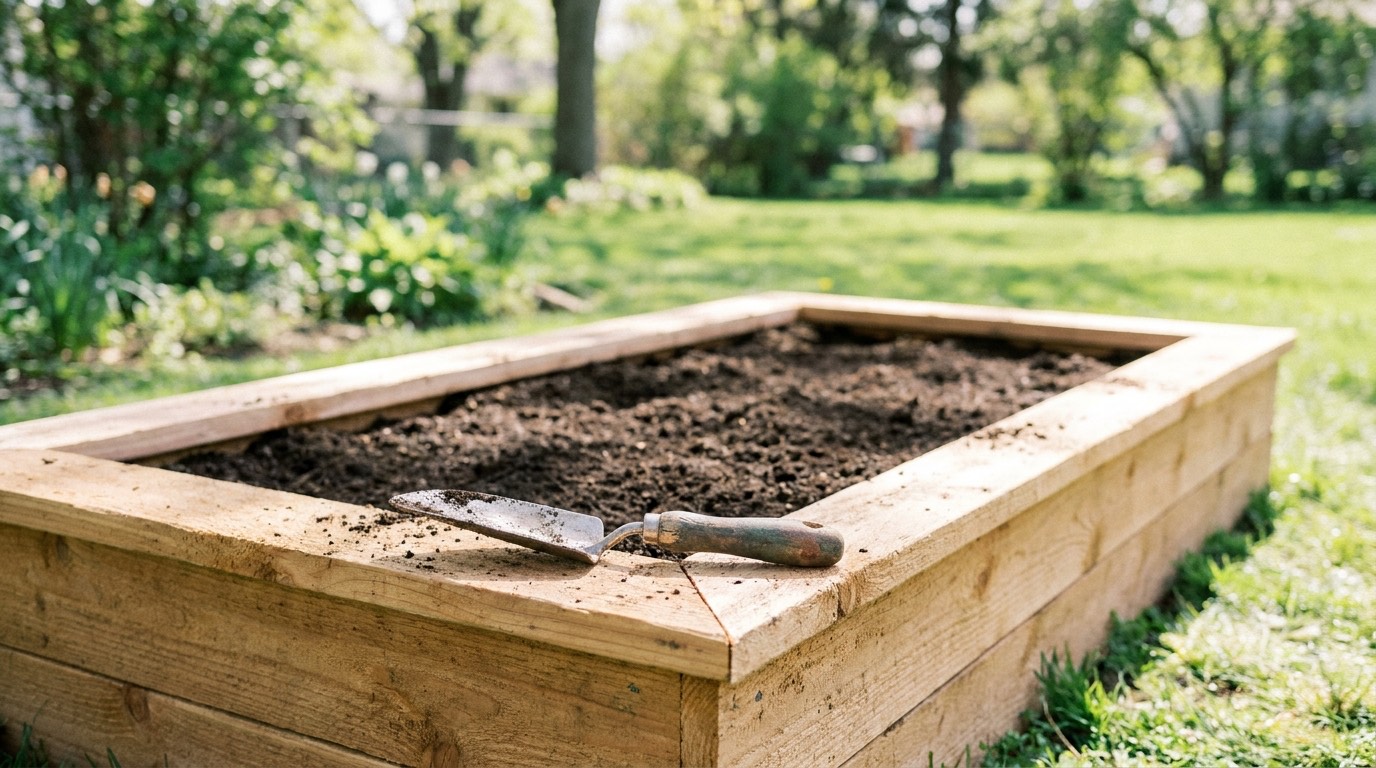
For most American beginners, a raised bed is the single best way to start growing vegetables. You skip the biggest obstacle a new gardener faces — bad native soil — because you fill the bed with exactly the mix you want. You get fewer weeds, better drainage, soil that warms earlier in spring, and a growing surface that's kinder to your back and knees.
Here's how to plan, build, and fill your first one.
Where to put it — decide this first
A raised bed lives wherever you build it, so choose the spot carefully. Vegetables need at least 6 hours of direct sun a day — watch your yard and pick the sunniest, most level spot with easy access to a hose. Sun is the one thing you can't fix later.
Step 1: Pick the right size
The golden rule of raised beds: never make them so wide you can't reach the middle from either side.
- Width: 4 feet max. At 4 feet, you can reach 2 feet from each side without stepping into (and compacting) the bed. If it's against a wall, keep it to 3 feet.
- Length: whatever fits — 8 feet is a common, easy size that matches standard lumber.
- Height: 10–12 inches is plenty for most vegetables. Go 18+ inches if you want extra root depth or a taller bed that's easier to tend.
A 4 × 8-foot bed is the classic first bed — big enough to grow real food, small enough to manage. Our Plant Spacing Calculator will tell you exactly how many plants fit one.
Step 2: Choose your material
- Untreated wood — cedar and redwood naturally resist rot and last many years; they cost more. Pine or fir is cheap but rots faster (a few seasons).
- Avoid old pressure-treated lumber for edibles if you're unsure of its age. Modern treated wood (post-2003) is generally considered safe, but many gardeners still line it or choose cedar for peace of mind.
- Metal (galvanized) beds and stock tanks are popular, durable, and increasingly affordable.
- Concrete blocks or bricks need no building skills at all — just stack them into a rectangle.
Step 3: Build the frame
A basic wooden bed is four boards screwed into corner posts:
- Cut your boards to length (or have the store cut them for free).
- Stand them into a rectangle and screw each corner to a short 4×4 corner post or a metal bracket, using exterior screws.
- Set the finished frame in place and check it's level.
No workshop required — a drill and an afternoon is enough.
Step 4: Prepare the ground under it
- On grass or weeds, lay a few sheets of plain cardboard across the bottom before filling. It smothers what's below and breaks down naturally.
- You do not need to dig up the lawn first — the cardboard-and-fill method works fine.
- If burrowing pests (voles, gophers) are a problem in your area, staple hardware cloth across the bottom.
Step 5: Fill it with the right mix
This is what makes or breaks a raised bed. Do not fill it with plain garden soil or bagged "topsoil" — both compact into a dense, poorly draining brick.
A good, simple raised-bed recipe is roughly:
- 60% topsoil or bagged raised-bed soil
- 30% compost (this is the engine — don't skimp)
- 10% aeration such as coarse perlite, or a mix of both
Or just buy bagged "raised bed soil" or "garden soil for raised beds", which is pre-blended for this. To estimate how much you need: length × width × depth (all in feet) = cubic feet. A 4 × 8 bed filled 10 inches deep needs about 27 cubic feet (one cubic yard) of fill.
Step 6: Plant it
Once filled, water the bed thoroughly to settle the mix, top it off if it sinks, and you're ready to plant. Because the soil is loose and rich, you can space plants a little closer than in the ground — again, the Plant Spacing Calculator has you covered.
Raised beds in six points
- Full sun first — 6+ hours, chosen before anything else.
- 4 feet wide, max so you can always reach the middle.
- Cedar, metal, or blocks — untreated and long-lasting.
- Cardboard on the bottom, no digging required.
- Never fill with plain garden soil — use a compost-rich raised-bed mix.
- Water to settle, then plant a little closer than in the ground.
Keeping it going
Raised beds drain faster than open ground, so they need more frequent watering in summer — check the top inch or two and don't let it dry out completely. Each spring, top the bed with a fresh inch or two of compost to replace what the plants used. Do that, and one good bed will feed you for years.
Frequently Asked Questions
How deep should a raised garden bed be?
Ten to twelve inches is plenty for most vegetables. Go 18 inches or more if you want extra root depth for carrots and other root crops, or a taller bed that's easier on your back.
What should I fill a raised bed with?
Use a compost-rich raised-bed mix — roughly 60% topsoil or bagged raised-bed soil, 30% compost, and 10% aeration like perlite — or buy bagged "raised bed soil." Never fill it with plain garden soil.
How much soil do I need for a 4x8 raised bed?
A 4 by 8 foot bed filled about 10 inches deep needs roughly 27 cubic feet of soil — about one cubic yard. Multiply length by width by depth in feet to estimate any bed.